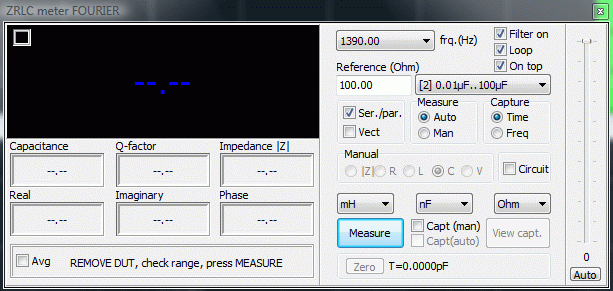
ZRLC turns VA into a complex-impedance meter. With simple external hardware and a reference resistor, the program derives magnitude, phase, real and imaginary parts and—according to the selected model—equivalent R, L and C values.
Measurement method
The generator applies a signal to a network containing the unknown component and a known resistor. The two channels acquire related quantities; their complex ratio lets VA determine impedance. Accuracy depends on the reference resistor, calibration, signal levels and phase measurement quality.
- Impedance magnitude and phase
- Real and imaginary components
- Series and parallel models
- R, L, C, Q and D
- Frequency-domain sweeps
- Calibration, averaging and uncertainty evaluation
Hardware and safety
ZRLC requires an external interface because an audio interface cannot be connected directly to arbitrary circuits. The project published by Nuova Elettronica includes protection, switching and connections for the intended measurements.
Applications
Characterising resistors, capacitors and inductors; loudspeaker impedance curves; resonance detection; component comparison; equivalent-circuit studies.
Read more in the Visual Analyser Handbook
This page is an operational introduction. Chapter 7 — ZRLC hardware and measurement of the forthcoming book covers theory, controls, algorithms, examples and measurement notes in much greater depth.